
Searching Madison County Criminal Dockets
For a Superior Court matter, the Madison County Clerk of Superior Court is the official starting point. The site links both Case Search and Court Calendars. The case-management side sits behind a login and session boundary, so treat those controls as a wall rather than a free public index. The calendar page is the better open route. It publishes dated PDF setting lists anyone can open.
Match the court named on your notice. Superior matters call for the case number plus the matching calendar. A warrant, first appearance, bond, bad-check matter, or county-ordinance case belongs to Magistrate Court first. A city citation goes to the municipal court that issued it. When the public route dead-ends, call the clerk. Have the court class, filing year, official name, and case type ready.
- Identify the court on the notice or summons.
- Copy the case number exactly, including letters and suffixes.
- Check the clerk's Case Search or current calendar PDF.
- Confirm the setting and status with the proper clerk.
- Request the docket, signed order, or certified copy needed.
Madison Criminal Calendar Fields
The public criminal motion calendar shows what Madison County criminal docket fields actually look like. Each entry can name the court, the presiding judge, the date, the time, the case number, and the State of Georgia caption. It can also carry more detail. Beyond that sit the count and the offense. The classification, the offense date, the attorney block, the bondsman, the bond amount, a bench-warrant date, and setting notes follow. Every field describes a scheduled matter. None of them, standing alone, proves a conviction or any final result.
| Case number | Observed formats include 26MR00004 and 26WR00236; no official prefix codebook was found. |
|---|---|
| Count and charge | Separate alleged offenses may be listed within one case. |
| Setting note | May identify sentencing, bond hearing, probation revocation, or a motion. |
| Bond fields | Procedural release information, not the final disposition. |
| Generated time | Helps distinguish an older PDF from a later version. |
Inside a Madison Criminal Docket
A full criminal docket covers more ground than a calendar. Filings, hearing settings, motions, pleas, court orders, and the eventual disposition can all appear in it. The PDFs Madison County offers are setting sheets, so they capture what the court expected to hear on one date. Keep the limits in mind. A motion calendar will not repeat every earlier filing. A trial order never means every listed matter actually reached trial.
Context decides what a field means. A charge is an allegation, not a verdict. A bench-warrant date is a procedural entry and nothing more. A sentencing label names the type of setting. The signed sentencing order remains the stronger source for the outcome. Madison County publishes no official disposition-code legend, so copy labels like “probation revocation hearing” exactly rather than guessing at an abbreviation or turning a calendar note into a final judgment.
Madison Magistrate Criminal Starts
The Madison County Magistrate Court is its own criminal starting point. Its official page lists the court's work. That work spans arrest warrants, first appearances, bond, extradition, committal, warrant-application hearings, and good-behavior bonds. It also covers county-ordinance violations, misdemeanor bad checks, and other authorized misdemeanors. The court is not a court of record. That sets its role apart from the Superior Clerk's countywide felony register.
Call the Magistrate clerk at 706-795-6375 for the right hearing or record route. The official page posts no public warrant list. A missing web result says little about whether a warrant application or first appearance exists. Ask the clerk for procedure, not legal advice. Give the exact court and matter names printed on your paperwork.
How a Madison Criminal Case Moves
Criminal cases do not all enter the Madison County criminal docket at the same door. A limited matter may start in Magistrate Court. A felony proceeds in Superior Court. There, calendar calls, motion settings, trial orders, and later disposition documents can all appear. Municipal ordinance and traffic matters begin in the city. That is the city that issued the citation. Let the caption and court name on the paperwork control your first route.
Docket flow: Filing or warrant › First appearance › Pretrial setting › Plea or trial › Disposition › Sentencing
Treat that sequence as a reading aid rather than a promise that every case shows every stage. A plea can end a matter without any trial. A motion may simply be continued. A probation-revocation setting follows an earlier sentence. To track the real sequence, use the Madison County case lookup route, and when the outcome matters, get the latest signed order.
Madison Motion and Trial Settings
Madison County publishes several named criminal calendar types: Criminal Calendar Call, Criminal Motion Calendar, Misdemeanor Status Calendar, and Criminal Trial. Each label answers a different scheduling question. A calendar call organizes pending cases. A motion calendar lines up requests for a judge's ruling. A status calendar checks where matters stand. A trial order sets procedure for matters expected to move toward trial.
The date baked into a PDF filename helps, but the newest notice and the clerk's word should control. Settings get reset and continued all the time. A generated timestamp can help you compare two copies. Still, the clerk site never says how often each PDF is refreshed. Never read an old file as proof that a later court date was canceled.
Courts That Hold Criminal Dockets
Felony prosecutions in Madison County belong to Superior Court. That court also serves as the general trial court for criminal matters. Katie Cross is the Clerk of Superior Court. Her office at 91 Albany Avenue in Danielsville holds the court's register and filings. Magistrate Court takes the limited early-stage and lower-court cases listed on its official page. Juvenile Court stands apart. It is its own court class, not part of the adult criminal docket search. City cases run through municipal courts. Danielsville's charter creates a Municipal Court, and Comer publishes a municipal ticket route. Carlton's charter covers traffic, ordinances, warrants, and certiorari. Not every city posts a public criminal lookup page. So check the municipality printed on your citation first. The Superior Clerk does not always hold the earliest docket. The Georgia court navigation resource lays out the state's court classes. It also explains how their jurisdictions differ.
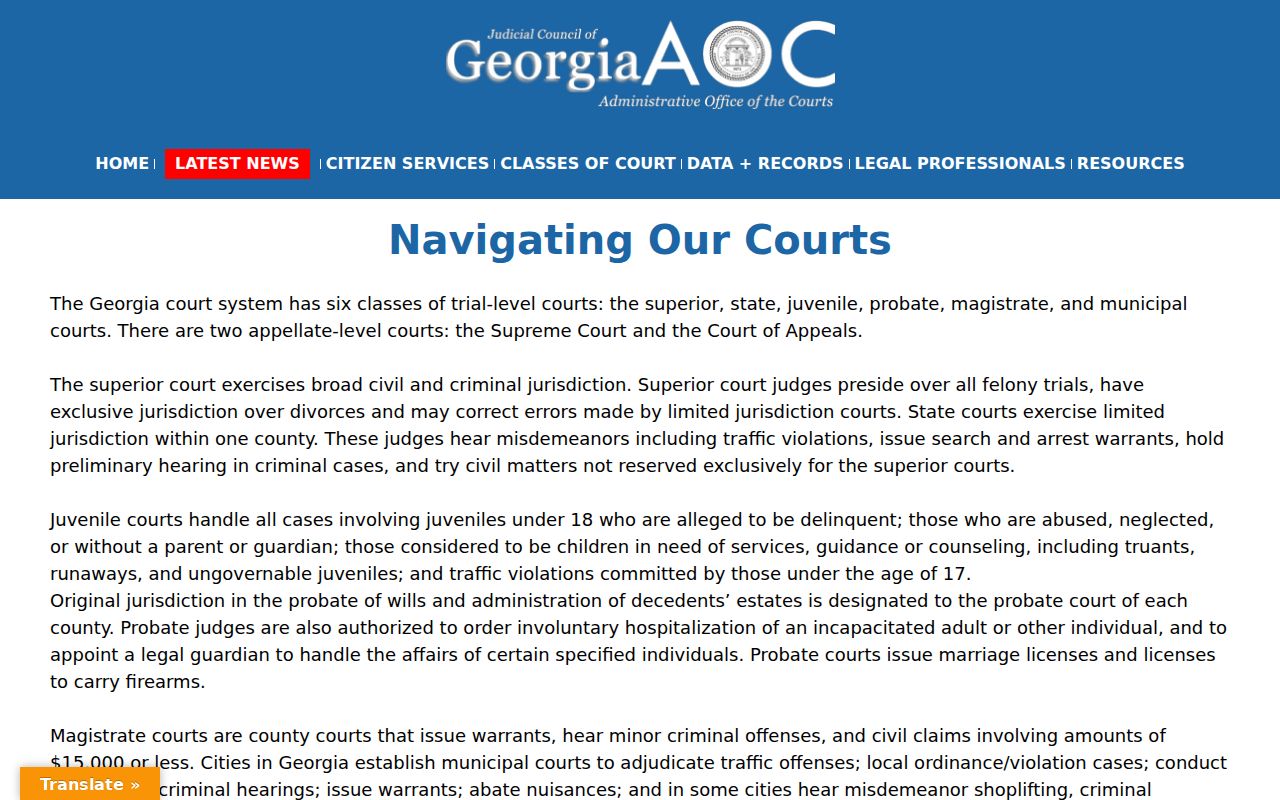
Why would one Madison County criminal search touch several clerks? The statewide court map shows the answer: courts of different classes sit in the same county, and each keeps its own docket.
Madison Bond and Warrant Entries
Bond amounts, bondsman names, and bench-warrant fields all show up in the Madison County criminal motion calendar sample. Treat them as procedural facts on the setting sheet, nothing more. A dollar figure is not a ruling. A bondsman entry is not proof of guilt. A motion to set aside a bench warrant is only a request queued for a judge. It is not an order already granted.
Read the latest order. When a calendar lists a bond hearing, bench-warrant motion, sentencing, or probation-revocation hearing, ask the Superior Clerk for the later docket entry or signed order before describing the result.
That distinction drives an accurate Madison County criminal docket search. Public setting data can locate a proceeding and show why it was scheduled, but only the official case file reveals the court's ruling.
Sealed Dockets and Public Access
Uniform Superior Court Rule 21 opens court records to the public. Law or a court order can say otherwise. It also spells out how material gets restricted. So a gap in a public calendar means little. Protected identifiers, protective-order details, sealed filings, and similar confidential matter should never be inferred from what a calendar leaves blank. Georgia's arrest-record restriction law works separately from the court docket. Restriction under O.C.G.A. § 35-3-37 does not wipe every court filing. Juvenile cases stay outside any adult Madison County criminal docket search. They follow their own confidentiality rules.
Access boundary: A blank result does not prove that no case exists. Contact the originating clerk when a case may be sealed, restricted, juvenile, newly filed, or absent because the portal session failed.
Madison Clerk Record Fallback
If WebCaseManagement stops at a login screen, pull the case number from the public calendar and call the right clerk. The Superior Clerk lists 706-795-6310 and P.O. Box 247, Danielsville, Georgia 30633. Be specific about what you need: a docket printout, a filed motion, a signed order, a plain copy, or a certified copy. Each is a different product, and the Superior Court publishes no copy fee. Magistrate matters go to that court's own clerk. Municipal matters go to the issuing city. PeachCourt can handle electronic filing and document access for participating matters once you have an account, but it is not a verified free index to every Madison County case. The originating clerk still has the last word.