
Searching the Colbert Court Docket
Begin with the document itself. A city traffic or ordinance notice should identify an issuing authority, response date, and contact. Because Colbert has not published a verified public case lookup, call City Hall before entering personal information into a statewide vendor. For a Superior civil, criminal, domestic-relations, protective-order, or lower-court appeal matter, use the Madison County Clerk of Superior Court's local Case Search and office channels. Magistrate and Probate maintain separate files, so neither is a substitute for the issuing municipal clerk.
- Read the notice for the issuing city or court, citation or case number, party name, and appearance date.
- Call Colbert City Hall at 706-788-2311 and ask whether the matter is handled through a Colbert municipal docket.
- Ask for the current lookup, payment, contest, records-request, and hearing-confirmation route; do not assume a vendor is authorized.
- If the document names a county court, use the appropriate Madison Superior, Magistrate, or Probate channel instead.
- Record the clerk's instructions and verify the date and location shortly before appearing.
When the caller has no citation in hand, begin with the full name and an approximate issue or hearing date, but let the clerk decide what additional identifiers are appropriate. The city sources do not publish anonymous name-search instructions. If City Hall cannot locate the matter, ask whether the issuing agency used another municipality or county court and whether there is a delay between issuance and entry. Keep the original notice until the court confirms closure. A third-party report, search-engine result, or neighboring court's database is not a substitute for that confirmation.
Before ending the call, repeat back the court name, address, date, and required response. Ask for an official web address if the clerk recommends an online service, because similarly named payment sites can serve unrelated courts. If the response concerns a pending case, distinguish administrative information from legal advice: staff may explain where and when to file, but they cannot choose a plea, predict an outcome, or advise whether a particular motion should be submitted. A lawyer or authorized legal-aid service is the appropriate source for strategy.
The Former School Is City Hall
Colbert's records geography has a useful local landmark. The official city history says City Hall moved from the old depot to the former Colbert School in December 2020. The working address is 60 West First Avenue, Colbert, Georgia 30628, not the historic depot or the Madison County Government Complex in Danielsville. Official contact hours are Monday through Friday, 8:00 a.m. to 1:00 p.m. A reader seeking municipal information should use the morning office window or telephone before traveling, particularly because no separate public court-counter schedule was found.
This location detail prevents two common mistakes: using an older city address associated with the depot, or going directly to the county courthouse merely because Colbert lies in Madison County. City Hall is the verified first contact for a notice that actually names Colbert.
Prepare for that contact the same way as a records request. Have the citation or notice in front of you, copy the identifying number exactly, and note the name, alleged violation, issuing agency, and printed deadline. Ask which office maintains the docket and whether the city accepts a request by telephone, mail, or in person. If staff directs you to another clerk or vendor, write down the destination and confirm that it applies to Colbert. Do not transmit a Social Security number, financial account number, or unrelated personal data. The research confirms the public city contact, but it does not establish what identification a clerk may require to release a particular restricted record.
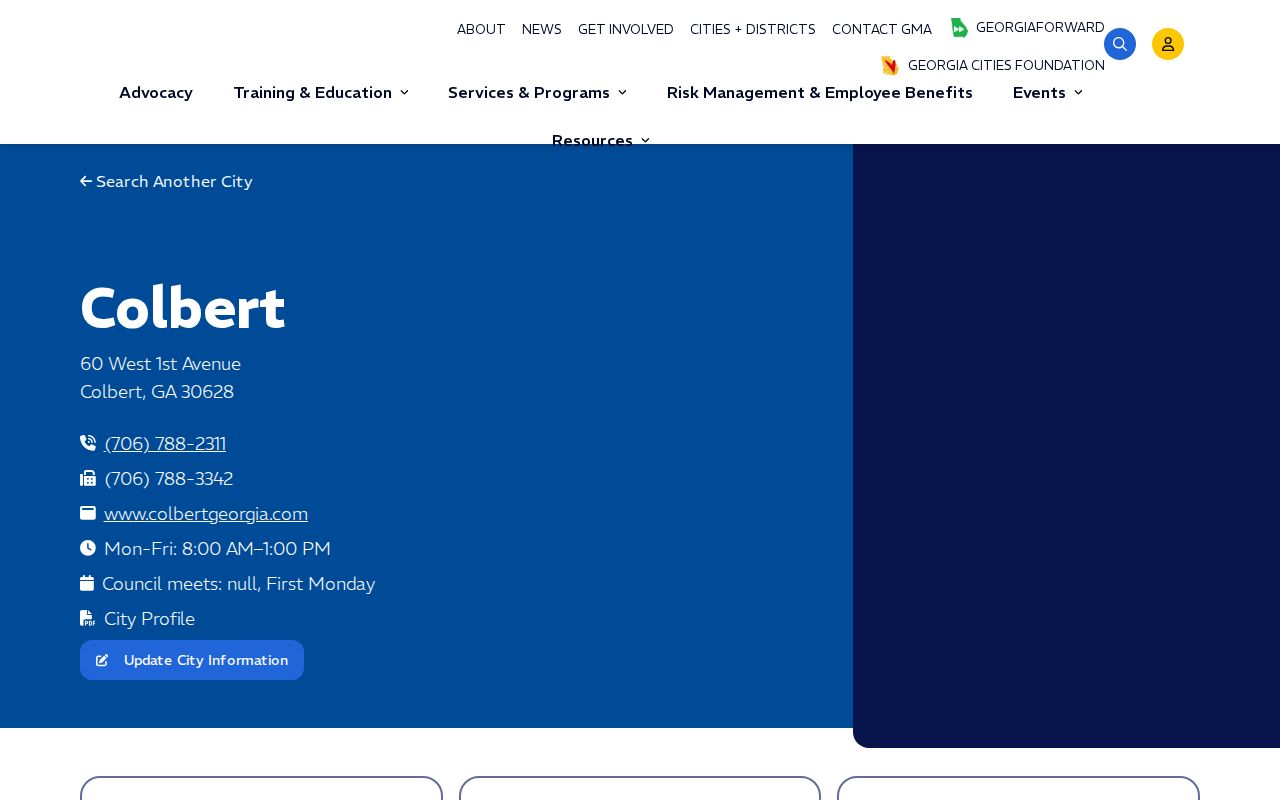
The Georgia Municipal Association profile supports the city identity and contact route used to begin a Colbert docket inquiry.
The association profile is supporting context rather than a live docket. Use it to identify Colbert, then confirm case-specific instructions with the city office.
The morning-hours detail matters for time-sensitive questions. Calling after the published window may leave too little time to resolve an appearance due the next day, so contact the office early and leave room for a referral. If a call is unanswered, preserve the notice, note when contact was attempted, and follow any official written instructions already provided. The sources do not confirm voicemail as a valid filing, plea, continuance, or appearance. Only the court can say whether a response has been accepted.
Colbert Municipal Court Basics
Georgia municipal courts generally hear city ordinance and traffic matters within their lawful jurisdiction. Colbert's official codes and ordinances page is the verified municipal-law starting point, but the reviewed city sources did not expose a current judge listing, hearing schedule, public docket, citation form, or payment provider. That gap calls for precise language: a citation naming Colbert should be routed to City Hall to confirm whether it is a Colbert Municipal Court matter and which clerk currently maintains it.
The city code is not the docket. It explains municipal law, while the docket records events in a particular case. Likewise, the absence of an online form is not proof that Colbert has no active municipal matters. The city clerk can identify the correct court contact, record-request method, and any distinction between a payable citation and a required appearance.
When speaking with the clerk, separate four questions that are often blended together: whether a case exists, when it is set, whether a response can be made without appearing, and how to obtain a copy. A clerk may answer each through a different channel. A payment provider might show an amount while offering no filed documents; a calendar might show a date but no disposition; and a municipal code page might explain the ordinance without mentioning any individual case. Keeping those products distinct produces a more reliable Colbert docket search and makes it easier for staff to route the request.
No Public Colbert Portal Found
Research located no official Colbert case-search fields, calendar feed, payment form, judge page, citation-number format, or posting schedule. That is an access finding, not permission to fill the gaps from another city's system. Comer has an official JusticeONE payment link, for example, but a Colbert ticket should never be sent to Comer's route unless Colbert itself or the citation expressly says so. Georgia's traffic guidance also warns that there is no centralized statewide citation database.
If a search returns nothing: recheck the issuing authority and number, then call City Hall. Ask whether the ticket has posted, whether a vendor is officially used, and whether the date printed on the citation remains controlling.
A blank result can have several ordinary explanations. A recently issued citation may not yet be entered, the searched number may include punctuation, the matter may sit in a county rather than city court, or public display may be limited. Colbert's sources do not publish name-order rules, wildcard instructions, date-range filters, or an expected posting interval. Rather than retrying unrelated services, give City Hall the minimum information needed to identify the responsible office. If the clerk says a record is unavailable to the public, ask whether the reason is a restriction, an unscanned file, or a different custodian; do not ask staff to disclose protected contents.
Searchers should also distinguish an agency from a court. The department or officer that issued a citation may appear prominently on the paper, while a different line names the tribunal that receives the case. Direct the docket question to the tribunal or clerk, not merely to the enforcement agency. If the paper is illegible, ask City Hall to identify the route from the citation number and issue date. Never guess that every event occurring inside Colbert belongs on a Colbert municipal docket.
Court Dates and Settings in Colbert
No official Colbert settings calendar or recurring docket day was found, so do not borrow Madison Magistrate's monthly patterns or a neighboring city's session schedule. The date on the current citation or court notice is the starting point. Confirm it with the designated clerk, especially after a continuance request, weather event, amended notice, or any verbal instruction. A reset changes a setting; it does not automatically dismiss the underlying matter.
| Date | Use the current notice and ask whether a later order or reset replaced it. |
|---|---|
| Time | Confirm whether it is a docket call or an individual appearance time. |
| Location | Ask for the exact room and address; do not assume City Hall or the county complex. |
| Presiding Official | No current public Colbert judge listing was located; confirm with the clerk. |
| Setting Type | Ask whether the event is an arraignment, plea, hearing, trial, compliance date, or another local setting. |
Confirm all five fields together. A correct date paired with the wrong court or location can still produce a missed appearance. If an employee gives a new date by telephone, ask whether the court will issue a written notice and how it will be delivered. The research did not locate a Colbert online continuance request, and a request by itself does not change a setting. Continue to treat the existing date as active unless the court grants the change. For emergency closures or weather, use the city contact and any official notice rather than social-media reposts.
A Notice Is Not a Disposition
A citation, calendar listing, and final disposition answer different questions. The citation begins the route and gives initial instructions. A setting shows when the court expects activity. A disposition records what the court ultimately decided. Do not treat the stated violation as a finding, and do not assume that a payment screen proves the official case status. When proof of the outcome is needed, request the disposition or a certified court record from the clerk that handled the matter.
Colbert did not publish a field legend explaining its citation or status codes. Ask the clerk to interpret any abbreviation rather than importing a definition from a different Georgia court.
The same caution applies to financial fields. An amount displayed by a payment service could be a current balance, a scheduled fine, or a transaction total that includes a vendor charge. It is not automatically the clerk's certified statement of the case. If a deadline or legal consequence depends on payment, ask whether the court received and posted it and save the official confirmation. If the goal is to show how a matter ended, request the disposition rather than relying on a receipt. No Colbert-specific late-fee, failure-to-appear, amnesty, or defensive-driving program was verified, so those subjects must be answered by the court handling the citation.
Also ask whether multiple notices refer to one case or separate matters. Names, dates, and similar allegations are not enough to merge records. Match every document by court and case or citation number, and keep each deadline separate until the clerk confirms otherwise. This avoids applying a payment, reset, or disposition from one proceeding to another.
Traffic Tickets in Colbert
For a ticket naming Colbert, read the issuing-court line before searching. Call City Hall with the citation number, name exactly as printed, date of birth only if the clerk says it is needed, and the listed appearance date. Ask whether the matter is searchable online, payable without appearance, or requires a court response. No verified Colbert online payment or name-search channel was found.
Paying and contesting are different choices with possible legal and licensing effects. Follow only the issuing court's current instructions and meet the citation deadline. A vendor convenience screen does not decide whether payment is permitted or what plea follows. The Madison County traffic tickets page explains the broader city-versus-county routing and the separate Georgia DDS driving record.
Georgia DDS receives qualifying conviction information from courts through its electronic reporting system, but a driver's record and the court file remain different records. Resolve a failure-to-appear question first with the court that reported it, then use DDS for license status. Do not ask Colbert City Hall to interpret a driving record or eligibility for a particular plea. Those questions may require DDS information or legal advice. No official Colbert policy for online pleas, mailed pleas, payment plans, or representation was found. The safest course is to ask before sending money or missing the stated appearance.
Colbert in the County Plan
Colbert had 630 residents in the 2020 Census, making it one of Madison County's five largest incorporated places used for these city docket routes. The joint county-and-cities comprehensive plan supplies municipal context but is not a court record or session calendar. Its value is structural: Colbert is a distinct incorporated city, so its municipal notices should not be collapsed into Danielsville, Comer, or a generic county search.
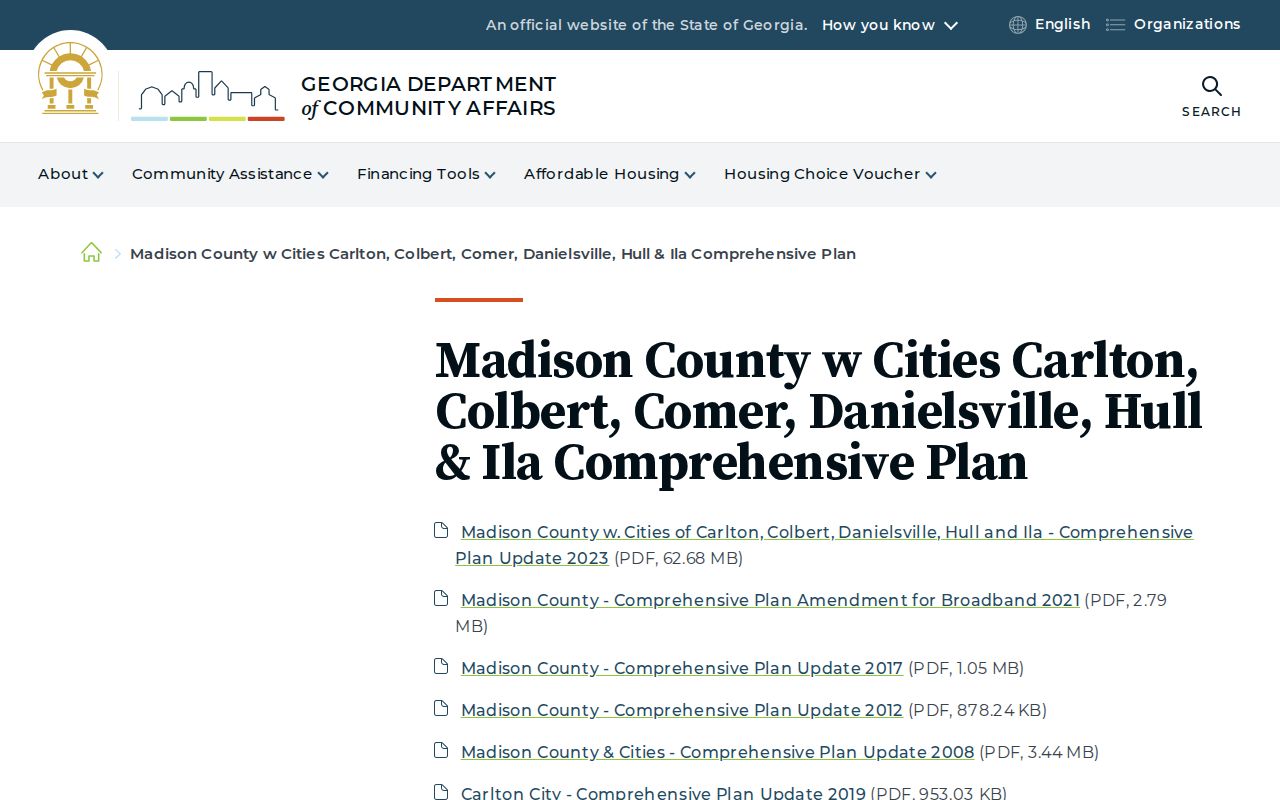
The Georgia Department of Community Affairs source places Colbert within Madison County's network of separate municipalities.
The planning source helps establish local context only. For a date, balance, plea, or official copy, return to the citation and the responsible court clerk.
Local scale does not merge jurisdictions. A resident may encounter a city ordinance matter, a county warrant or limited civil matter, a Superior Court case, or a Probate issue, each with a different custodian. The Georgia Courts case-count dashboard did not supply a public Colbert docket portal or a city case total that could safely be presented as current. Population likewise says nothing about annual filings. The useful conclusion is procedural: begin with the named court, not with assumptions about where most cases in a small city must go. When the notice is ambiguous, Colbert City Hall can clarify whether the question belongs locally before the reader contacts Danielsville.
The city profile and comprehensive plan also serve different evidence roles. The profile supports municipal identity and contact context; the plan shows Colbert as part of a coordinated county planning area. Neither source reports court outcomes. That separation is deliberate: civic background can help a reader find the correct government office, but it should never be used to infer that a person has a case, that a ticket remains unpaid, or that a local court follows a procedure not stated by an official court source.
Where Colbert Cases Go
Municipal jurisdiction does not absorb every case arising within a city. Superior Court is Madison County's general-jurisdiction court for felonies, broad civil and domestic-relations matters, equity, and qualifying lower-court appeals. Magistrate handles its limited civil, warrant, dispossessory, garnishment, bad-check, and specified ordinance work. Probate has separate subject matter. The originating document and governing procedure, not the party's Colbert address, determine the correct docket.
Docket flow: Colbert municipal route › appropriate Madison County clerk › Superior Court of Madison County when jurisdiction or a lawful review route places the matter there
Use the Madison County court docket overview when a notice names a county court. Do not assume Superior Court is an automatic appeal destination for every city decision: no Colbert-specific current appeal text was verified in the reviewed material. The city or receiving clerk should confirm the route.
A county-level search should also begin with a case number or exact party name from the notice. Madison's Superior calendar PDFs can help identify a current setting, but a calendar is not the complete file. PeachCourt may provide file-stamped documents after account access, while the clerk supplies official copies and certification. For a limited civil claim, dispossessory, garnishment, or warrant matter, Magistrate Court may be the correct counter. For an estate or guardianship matter, Probate Court is separate. This division explains why a single search for “Colbert court” cannot reliably return every relevant record.
Danielsville Is a Different Stop
County-level court offices operate from the Madison County Government Complex at 91 Albany Avenue in Danielsville. That is different from Colbert City Hall at 60 West First Avenue. Katie Cross, Clerk of Superior Court, can be reached at 706-795-6310 for Superior matters; Magistrate and Probate have their own clerk offices. A Colbert resident should travel to Danielsville only when the notice, city clerk, or case type places the matter in a county court.
The distinction also affects searches. Madison Superior's local Case Search can help with Superior files, but it does not replace a municipal inquiry. Conversely, Colbert's codes page cannot supply a Superior judgment or certified county record. Match the office to the record before requesting a copy.
At the county level, online access also has boundaries. The Madison Superior Case Search exposed a login or session path during research, and Georgia's E-Access directory routes participating Superior documents through PeachCourt accounts. If a Colbert-related county case cannot be found there, the fallback is the appropriate clerk, not a conclusion that no case exists. Give Katie Cross's office a case number when possible and identify whether the request concerns the docket, a filed pleading, a signed order, or certification. For Magistrate or Probate subject matter, contact that separate office. Federal cases involving a Colbert party belong in PACER and the Middle District of Georgia, not any city or county docket.
Depot History and Record Location
Colbert's railroad and cotton history explains why older references may point toward the depot. The city once used that historic building for municipal functions before moving City Hall to the former school. For present-day court routing, nostalgia is not an address: use the city's current West First Avenue contact and ask where the record is physically maintained. If an older municipal file was created before the move, request that staff check whether it remains onsite, has been archived, or is held by another authorized custodian.
This history also illustrates why search results must be checked against current government information. A map listing, directory, or archived page can identify Colbert without establishing today's court room, office hours, or clerk procedure. The current office should resolve any conflict.
Older records present a related practical question: where the record went after an office move. The research does not establish a Colbert archive, retention schedule, microfilm collection, or electronic conversion date. Ask the city whether a historical docket remains with the clerk, was transferred, or requires a written request. Describe a date range and record type instead of asking staff to search every municipal file under a common surname. If the response points to Madison County, verify the receiving court and case type before using the Superior portal. Historical municipal papers and current county court records are not interchangeable merely because both concern Colbert.
For a written inquiry, use neutral locating details and a narrow scope. Request “the docket and final order for case number X” rather than every record connected with a person. Ask where fees should be sent only after the custodian confirms the amount and accepted method. No official Colbert copy price, certification charge, mailing instruction, or electronic-delivery policy was located. Naming those gaps protects readers from relying on fees or procedures copied from a different city.
Colbert Court Record Access Rules
Public access does not mean every record is anonymously searchable or unrestricted. Ask Colbert City Hall who acts as custodian for the municipal file and how to request the docket, citation, order, or disposition. Give the case or citation number, party name, approximate date, and desired document. State whether an ordinary copy or a certified copy is needed, then request the current fee and delivery method. No Colbert-specific fee schedule, identification rule, or turnaround was found, so none should be inferred.
A plain copy may be enough for personal reference, while an agency, court, or other recipient may demand the clerk's certification. Ask the intended recipient before paying for certification. If the city cannot certify the item, request the name of the office that can. Transcripts are another distinct product and may involve a court reporter rather than the clerk; no local transcript contact or rate was found. Requests should avoid protected personal identifiers and should never be framed as consumer screening. This private resource does not host Colbert case files, submit requests for visitors, or determine who is entitled to restricted material.
After receiving a record, compare its case number and court name with the request. A certified copy should bear the authentication supplied by the responsible clerk; a downloaded screenshot or vendor receipt is not equivalent. If two sources conflict, ask the clerk whether one is older, incomplete, or tied to a different proceeding. Court information changes as filings are entered and settings move, so preserve the issue date of any copy and verify time-sensitive facts again before relying on them.
Key access rules:
Georgia Attorney General Open Government FAQ explains the state's access framework while cautioning that court records may follow court and clerk procedures.
Uniform Superior Court Rule 21 supplies the public-access framework for Superior files and allows lawful restrictions; it is relevant if a Colbert matter reaches that court.
Restricted, juvenile, sealed, and protected-identifier material may not be available to the general public. Ask the maintaining clerk what access order or request process applies.
If access is denied or limited, ask for the reason and the governing procedure rather than trying to obtain the same material from an unofficial source. A record may be sealed, confidential, protected by a court order, held by a different clerk, or simply unavailable online. Adult and minor guardianship matters are confidential on the Madison Probate route, and juvenile cases follow separate rules. Public-facing docket information can also omit protected identifiers. The signed order and the clerk's certified record control when a portal summary, calendar, or cached result conflicts with the official file.